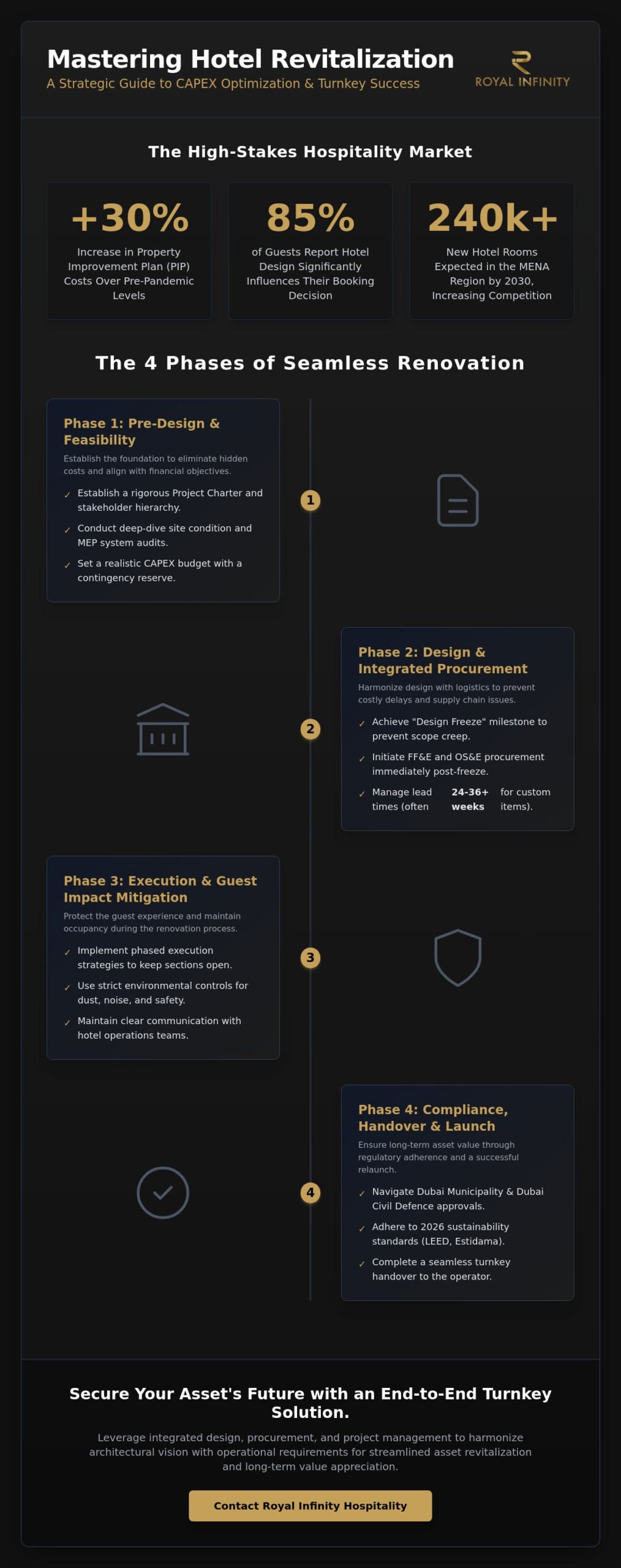
With the cost of Property Improvement Plans (PIPs) escalating by more than 30% over pre-pandemic levels, can your investment portfolio truly afford the traditional, fragmented approach to asset revitalization? In the high-stakes hospitality market of the United Arab Emirates, where over 240,000 new rooms are expected in the MENA region by 2030, you likely recognize that a renovation is a complex orchestration of financial logic and brand preservation. It’s a common concern that unforeseen site conditions often lead to budget overruns or that delayed FF&E deliveries stall room handovers, directly impacting your bottom line and guest satisfaction scores.
This strategic guide offers a sophisticated methodology for hotel renovation project management designed to optimize CAPEX and ensure a seamless, turnkey delivery. You’ll discover how to navigate the intricate requirements of brand standards and Dubai Sustainable Tourism mandates while maintaining elite levels of operational efficiency. We’ll examine the critical role of integrated procurement and design consultancy in minimizing downtime and securing the long-term appreciation of your hospitality assets.
Key Takeaways
- Establish a rigorous project charter and conduct deep-dive feasibility assessments to eliminate hidden costs before construction begins.
- Master the complexities of hotel renovation project management by integrating FF&E and OS&E procurement into the earliest stages of the lifecycle to ensure lead-time compliance.
- Implement phased execution strategies and strict environmental controls to protect the guest experience and maintain occupancy during the renovation process.
- Navigate the specific regulatory landscape of the United Arab Emirates, including Dubai Municipality approvals and 2026 sustainability standards like LEED and Estidama.
- Leverage end-to-end turnkey solutions to harmonize architectural design with operational requirements for a streamlined asset revitalization.
The Strategic Phases of Hotel Renovation Project Management
Executing a successful asset revitalization in the competitive United Arab Emirates hospitality sector requires more than just a contractor; it demands a strategic orchestration of asset preservation and market repositioning. A sophisticated approach to hotel renovation project management begins with the establishment of a comprehensive project charter. This document serves as the foundation for the entire lifecycle, defining the stakeholder hierarchy and ensuring that every decision aligns with the owner’s long-term financial objectives. Without a clear hierarchy, communication often becomes fragmented, leading to the delays and budget overruns that plague less structured projects.
The project manager acts as the single point of accountability, bridging the gap between the aesthetic vision of designers and the pragmatic requirements of operators. By applying rigorous project management principles, the manager ensures that the renovation scope is clearly delineated. Whether the project involves a soft goods refresh or a full adaptive reuse, defining these boundaries early prevents scope creep. This clarity is essential when managing high-stakes investments where every day of room inventory loss translates to significant revenue displacement.
Phase 1: Pre-Design and Feasibility
This initial phase focuses on mitigating “hidden” costs through deep-dive feasibility and site condition assessments. Given that 85% of guests report that a hotel’s design significantly influences their booking decision, analyzing market trends is vital to ensure the property meets 2026 guest expectations. In properties across Dubai and Abu Dhabi, architectural audits of existing MEP (Mechanical, Electrical, and Plumbing) and structural systems are mandatory. These audits identify whether aging infrastructure can support modern smart-room technologies or if they require a complete overhaul. Setting a realistic CAPEX budget at this stage, complete with a healthy contingency reserve, protects the owner from the 30% cost increases recently observed in Property Improvement Plans (PIPs).
Phase 2: Design Management and Brand Alignment
Ensuring that architectural consultancy aligns with global brand standards is a critical component of maintaining the asset’s value. A primary objective during this phase is the “Design Freeze,” a strategic milestone that prevents costly late-stage alterations which often derail construction schedules. Coordinating between interior designers and procurement specialists early in the process allows for the seamless integration of bespoke elements, particularly when developing specialized boutique hotel solutions for unique brand identities. This early collaboration ensures that the design is not only aesthetically superior but also logistically viable and compliant with local UAE regulations, such as Dubai Civil Defence requirements.
Integrating FF&E and OS&E Procurement into the Project Lifecycle
Procurement is frequently treated as a secondary operational phase, yet in high-caliber hotel renovation project management, it must act as the primary driver of the construction schedule. The reality of the 2026 market is that custom luxury items often require lead times exceeding 24 to 36 weeks. If procurement follows the construction start date rather than preceding it, the project is destined for costly delays and revenue displacement. Owners must ensure that the Design Freeze triggers immediate purchase orders to hedge against price fluctuations and the ongoing global supply chain volatility that continues to impact the $107 billion global FF&E market.
A strategic approach to Furniture, Fixtures & Equipment (FF&E) involves more than just purchasing; it’s the orchestration of brand standards with financial discipline. Every decision made during the procurement phase directly influences the project’s CAPEX efficiency and long-term asset value. Managing Operating Supplies & Equipment (OS&E) is equally vital, as these guest-facing items must perfectly match the updated brand identity to satisfy the 85% of guests whose booking decisions are influenced by design excellence.
Strategic Sourcing and Vendor Selection
The selection of vendors transcends mere price comparison. It requires a rigorous evaluation of quality, production capacity, and ethical governance to ensure compliance with modern standards. Engaging a specialized hospitality procurement consultancy Dubai allows owners to leverage established global networks and achieve cost-saving synergies through sophisticated negotiation. This process must include strict factory inspection protocols and sample approval stages to ensure that every piece of furniture meets the exacting standards of the brand. For unique properties, this precision is even more critical, as bespoke OS&E must be meticulously sourced to resonate with the specific expectations of the 2026 traveler.
Logistics and Warehouse Management
Effective logistics management is the silent backbone of a successful renovation. Coordinating Just-in-Time deliveries is essential in land-constrained markets like Dubai, where on-site storage is often non-existent or prohibitively expensive. A sophisticated logistics plan involves staging FF&E in off-site, climate-controlled warehouses before orchestrating white-glove installations. This methodical approach ensures that luxury finishes are protected from the dust and vibration of ongoing construction. By the time the operational handover occurs, every item of OS&E must be staged and ready for use, ensuring that the transition from construction site to luxury destination is seamless. To explore how these complex moving parts can be unified into a single vision, consider the advantages of turnkey procurement solutions tailored for the Middle Eastern market.
Mitigating Operational Downtime and Guest Impact
Managing a live asset renovation requires a profound understanding of the “Operator Mindset.” Unlike new builds, hotel renovation project management in an active property must prioritize revenue preservation and guest satisfaction above all else. Owners must treat the hotel staff as primary stakeholders, as their ability to maintain service standards is directly linked to the project’s success. This necessitates the implementation of strict noise, dust, and vibration controls. Using acoustic barriers and HEPA-filtered dust partitions ensures that the guest experience remains uncompromised despite the proximity of construction. Effective communication protocols, including personalized notices to guests and updated digital signage, manage expectations and protect the property’s online reputation during the transition.
A sophisticated project manager understands that the hotel is a business first and a construction site second. By establishing clear “quiet hours” that align with guest sleep patterns and dining schedules, the project team can maintain progress without triggering negative social media feedback. It’s essential to create a narrative of improvement, where guests feel they’re witnessing the birth of a new standard of luxury rather than being inconvenienced by a renovation. This careful balancing act is what separates a successful asset upgrade from a logistical failure that damages the brand’s long-term standing.
Phased Room Handovers and Mock-up Rooms
A successful execution strategy relies on the establishment of a “Golden Room,” which serves as the definitive benchmark for quality and brand alignment. This mock-up allows stakeholders to identify potential installation challenges before they scale across hundreds of units. In the United Arab Emirates, scheduling these phases during low-occupancy periods, such as the peak summer months, minimizes financial displacement. By renovating floors in vertical stacks or horizontal wings, project managers can maintain a buffer zone between guests and active work zones. This phasing must also account for back-of-house areas, ensuring that service flow and employee amenities are upgraded without hindering the staff’s ability to deliver luxury service.
Staff Training and Operational Readiness
The transition from a construction site back to a luxury environment requires meticulous planning. As rooms are handed over, the focus shifts to operational readiness. This involves syncing the construction finish with staff training on new smart-room technologies and updated service protocols. It’s not enough to simply hand over the keys; the team must be fully “onboarded” to the new asset’s capabilities. Establishing a rapid-response “snagging” team ensures that any minor defects are rectified immediately, preventing negative reviews. This methodical approach ensures that the property doesn’t just look new; it operates with the polished elegance that elite travelers expect. By treating the final handover as a performance, rather than just a construction milestone, owners secure their ROI from day one.
Regional Compliance and Sustainability in the Middle East
The regulatory landscape of the United Arab Emirates presents a unique set of challenges that demand a high level of precision in hotel renovation project management. Compliance with Dubai Municipality and Civil Defence standards is not a mere administrative step; it’s a critical safety and legal requirement that dictates the project’s velocity. Failure to align with updated regional fire and life safety codes can result in immediate stop-work orders, causing cascading delays that erode your ROI. By integrating these compliance requirements into the initial project charter, owners can ensure that every architectural modification and MEP upgrade meets the stringent expectations of local authorities from the outset.
Modern asset revitalization also requires a rigorous approach to waste disposal and recycling in accordance with local regulations. In Dubai, hotels must adhere to the 19 Sustainability Requirements established by Dubai Sustainable Tourism (DST), which mandate specific management approaches for energy, food, and water. Adopting a circular economy approach during the construction phase doesn’t just ensure compliance; it positions the property as a leader in ethical hospitality. This methodical oversight ensures that the transition from a construction site to a functioning luxury hotel is both legally sound and operationally efficient.
Regulatory Navigation in the GCC
Successful execution in this region requires a deep understanding of the permit process and the ability to manage complex approvals across multiple agencies. This is where specialized hotel fit out project management becomes indispensable. It provides the oversight needed to ensure that fire suppression systems, emergency lighting, and structural changes are fully compliant before the final inspection. Proactive engagement with local authorities prevents the costly rework that often occurs when compliance is treated as an afterthought. It’s about securing the property’s license to operate while maintaining the highest standards of guest safety.
Sustainability as a Value Driver
Sustainability has evolved from a peripheral trend into a core requirement for modern hospitality assets. With 78% of guests now preferring hotels with documented environmental practices, integrating 2026 standards such as LEED or Abu Dhabi’s Estidama into your procurement strategy is essential. This shift toward “Green Hotels” involves more than just energy-efficient MEP systems; it requires the strategic sourcing of sustainable FF&E and OS&E. Investors and stakeholders increasingly demand transparent ESG metrics, making it imperative to document every sustainable choice. Implementing smart room technology for energy management can significantly reduce long-term operational costs, appealing to the 64% of guests willing to pay premium rates for eco-certified properties. To navigate these complexities with a partner who understands the intersection of luxury and responsibility, consider engaging a hospitality management consultancy that specializes in the Middle Eastern market.
Securing Turnkey Success with Royal Infinity
The success of a major asset revitalization depends on the seamless integration of diverse disciplines, a feat rarely achieved through fragmented vendor management. Royal Infinity Hospitality Management LLC provides a holistic framework for hotel renovation project management that transcends traditional vendor-client relationships. By assuming end-to-end oversight from the initial architectural design phase to the final placement of OS&E, we eliminate the communication gaps that typically lead to budget drift and scheduling conflicts. A centralized consultancy model is fundamentally superior because it provides a single point of truth for both financial and aesthetic decisions, ensuring that brand standards are used as a non-negotiable benchmark for every procurement and installation milestone.
Transparency serves as the cornerstone of our methodology. We implement real-time budget and schedule tracking, allowing owners and stakeholders to maintain total oversight without the burden of day-to-day logistical friction. In the high-stakes United Arab Emirates market, where guest expectations for 2026 are reaching new heights, having immediate access to project data is vital for informed decision-making. This rigorous approach to reporting ensures that CAPEX is optimized and that any potential risks are mitigated before they impact the project’s bottom line.
Tailored Consultancy for Luxury and Boutique Assets
High-end resorts and niche properties require a bespoke project management framework that respects their unique brand DNA. We specialize in providing boutique hotel solutions that bridge the gap between an architect’s aesthetic vision and the pragmatic financial reality of a CAPEX budget. Our process involves direct executive-level involvement in every renovation project, ensuring that strategic foresight is applied to every technical detail. This elite level of attention guarantees that the finished asset resonates with the sophisticated global traveler while adhering to the rigorous requirements of financial efficiency.
The Turnkey Advantage
The turnkey model is specifically designed to reduce the operational burden on hotel owners by providing total project ownership. By managing the entire lifecycle, from procurement consultancy to the final operational handover, we achieve a significantly faster speed-to-market for renovated assets. This efficiency is critical in the Middle East, where seasonal occupancy shifts dictate extremely tight construction windows. Long-term asset protection is secured through our meticulous quality control protocols, ensuring that every finish and fixture contributes to a sustained ROI and a superior guest experience from day one of the relaunch.
Elevating Asset Value through Strategic Revitalization
Navigating the complexities of a high-stakes asset upgrade requires a departure from traditional, fragmented methodologies in favor of a unified strategic lifecycle. You’ve seen how integrating procurement at the earliest design stages and maintaining a rigorous focus on regional compliance are essential for protecting your investment. Effective hotel renovation project management isn’t merely about construction; it’s the meticulous orchestration of brand standards, financial logic, and guest experience preservation. By prioritizing phased execution and 2026 sustainability standards, owners can secure a competitive edge in the evolving Middle Eastern hospitality market.
Royal Infinity stands as a guardian of your vision, offering turnkey solutions specifically designed for elite Middle Eastern resorts. Established in 2025, our firm combines the technical precision of FF&E and OS&E specialists with an unwavering commitment to modern industry standards. We invite you to consult with our hospitality project management experts today to discuss how a centralized consultancy model can transform your next renovation into a benchmark of operational excellence. Your property’s future deserves the steady hand of a partner dedicated to setting new standards for the luxury hospitality sector.
Frequently Asked Questions
What is the typical timeline for a full hotel guestroom renovation?
A comprehensive renovation lifecycle usually spans 12 to 18 months, encompassing pre-design feasibility, procurement lead times, and active construction. The physical renovation of guestrooms typically requires 4 to 6 months of on-site work, though this duration is heavily dependent on the efficiency of the initial planning phases and the complexity of the custom FF&E requirements.
How much should a hotel owner budget for FF&E in a luxury renovation?
Luxury asset owners typically allocate between د.إ 29,384 and د.إ 91,825 per guestroom for high-end Furniture, Fixtures, and Equipment. This range accounts for the superior materials and bespoke craftsmanship required to meet elite brand standards while ensuring long-term durability. It’s essential to include a contingency reserve to manage the 30% cost increases recently observed in global Property Improvement Plans.
What is the difference between a project manager and a general contractor in hospitality?
The project manager serves as the owner’s strategic representative, overseeing the entire ecosystem from procurement consultancy to design alignment. In contrast, the general contractor is a specialized vendor responsible for the physical execution of construction tasks on-site. The project manager ensures that the contractor’s work remains within the financial and aesthetic boundaries defined in the project charter.
How do you manage a hotel renovation while the property remains open?
Maintaining occupancy requires a phased execution strategy where specific wings or vertical stacks are isolated to create a buffer zone between guests and construction activity. Implementing strict environmental controls, such as acoustic barriers and HEPA-filtered dust partitions, is essential for protecting the guest experience. This methodical approach ensures that the property’s online reputation remains intact throughout the transition.
What are the most common risks in hotel renovation project management?
The primary risks include unforeseen site conditions related to aging MEP infrastructure and significant delays in the delivery of custom FF&E items. Sophisticated hotel renovation project management mitigates these threats through deep-dive feasibility audits and the integration of procurement schedules into the earliest stages of the project lifecycle. Without this foresight, scope creep and budget overruns become almost inevitable.
Why is a mock-up room essential before starting a full-scale renovation?
The mock-up room, or “Golden Room,” acts as a definitive quality benchmark that allows stakeholders to identify potential design flaws or installation challenges before mass production begins. This phase is critical for ensuring that the aesthetic vision aligns with operational requirements. It provides a physical space for the brand and the owner to finalize every detail, preventing costly rework later.
How can sustainable procurement reduce a hotel’s long-term operating costs?
Integrating energy-efficient MEP systems and sustainable materials can significantly lower utility expenses and maintenance requirements over the asset’s lifecycle. With 78% of guests preferring properties with documented environmental practices, sustainable procurement also acts as a revenue driver. Investing in smart room technology allows for precise energy management, directly enhancing the property’s overall financial efficiency and ROI.
What local Dubai permits are required for a major interior hotel renovation?
Major renovations in Dubai require approvals from the Dubai Municipality for structural and interior modifications, alongside Civil Defence permits for fire and life safety compliance. Additionally, any changes to utility infrastructure must be coordinated with the Dubai Electricity and Water Authority (DEWA) to ensure the property meets current standards. Navigating these requirements early is essential to avoid stop-work orders and project delays.
Related Posts